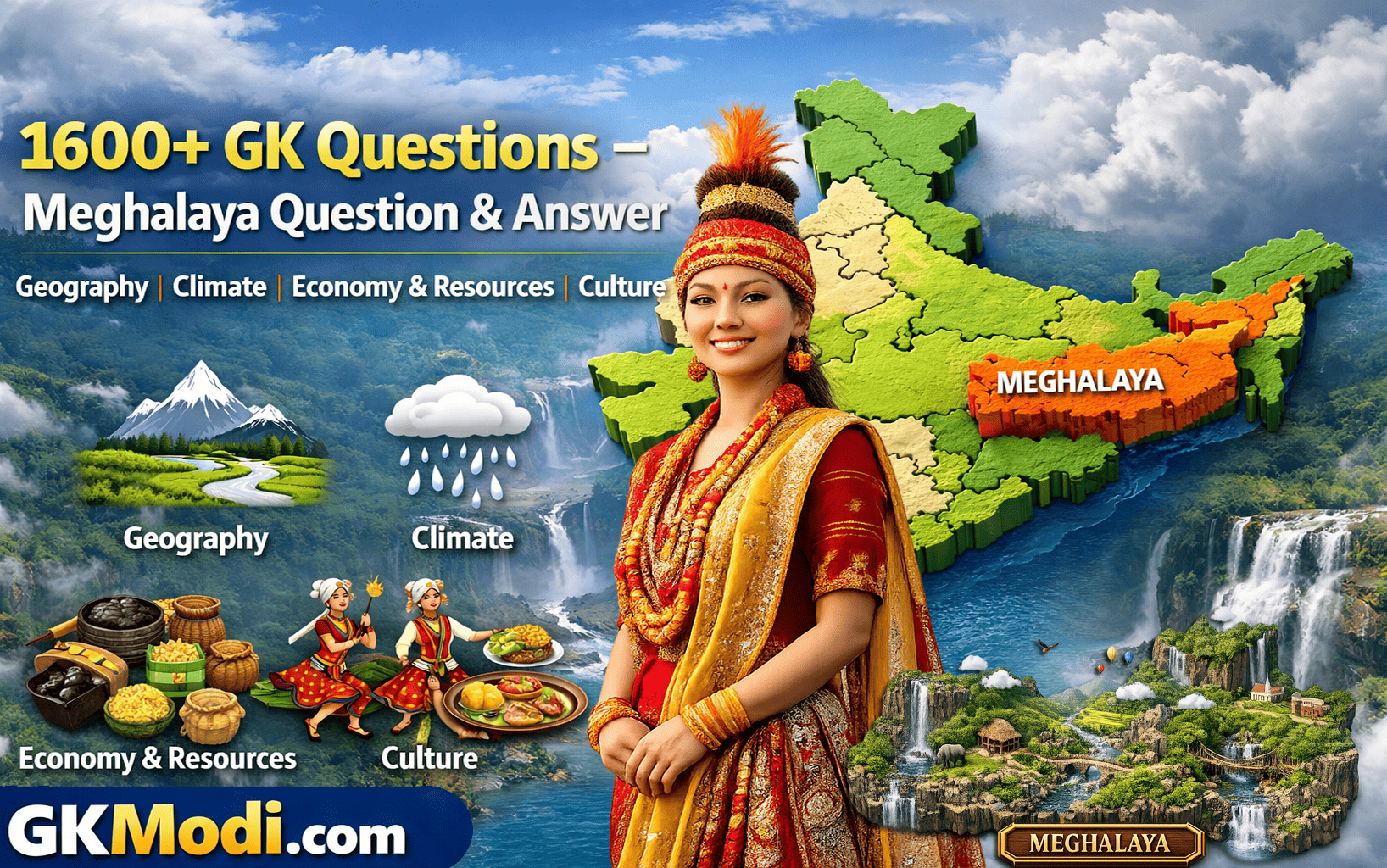
40 questions per page. Click "Show Answer" to reveal correct option and explanation. Meghalaya, formed in 1972 from Assam, is a scenic northeastern state known as the “Abode of Clouds.” Its capital is Shillong. Famous for heavy rainfall, living root bridges, caves, and waterfalls, it is dominated by Khasi, Garo, and Jaintia tribes, rich traditions, matrilineal society, biodiversity, and eco-tourism potential.
Start MCQs Read Article
Capital, tribes, history
Nohkalikai, Umngot
Khasi, Garo, Jaintia
1972, sacred forests
Fresh GK every week.
MCQs with reveal.
Smooth on any device.
Compete (soon).
1640 MCQs, displayed 40 per page (41 pages).
Yes, by local educators.
Use the contact info in footer.
On January 21, 1972, Meghalaya attained complete statehood in India. The North-Eastern Areas (Reorganization) Act of 1971 created it from the state of Assam. It was first established on April 2, 1970, as an independent state inside Assam.
The Himalayas in the north, the Western Ghats along the western coast, and the Eastern Ghats along the eastern coast are India's three primary mountain/hill range systems, which are essential to the country's geographical diversity. With the Himalayas being the highest and the Ghats being important hotspots for biodiversity, these systems are vital for controlling climate, supporting biodiversity, and functioning as water towers.
The major tribal communities in Eastern India differ by region: the Bodo are the largest plains tribe in Assam, the Khasi, Garo, and Jaintia are dominant in Meghalaya, and the Santhal are a significant group in West Bengal, Jharkhand, Odisha, and Bihar.
The Clouded Leopard (Neofelis nebulosa) is the official state animal of Meghalaya. This secretive wild cat lives in the area's deep forests and is distinguished by its huge, cloud-like markings. This fragile species, which lives in trees and has exceptional climbing abilities, is frequently found in Southeast Asia.