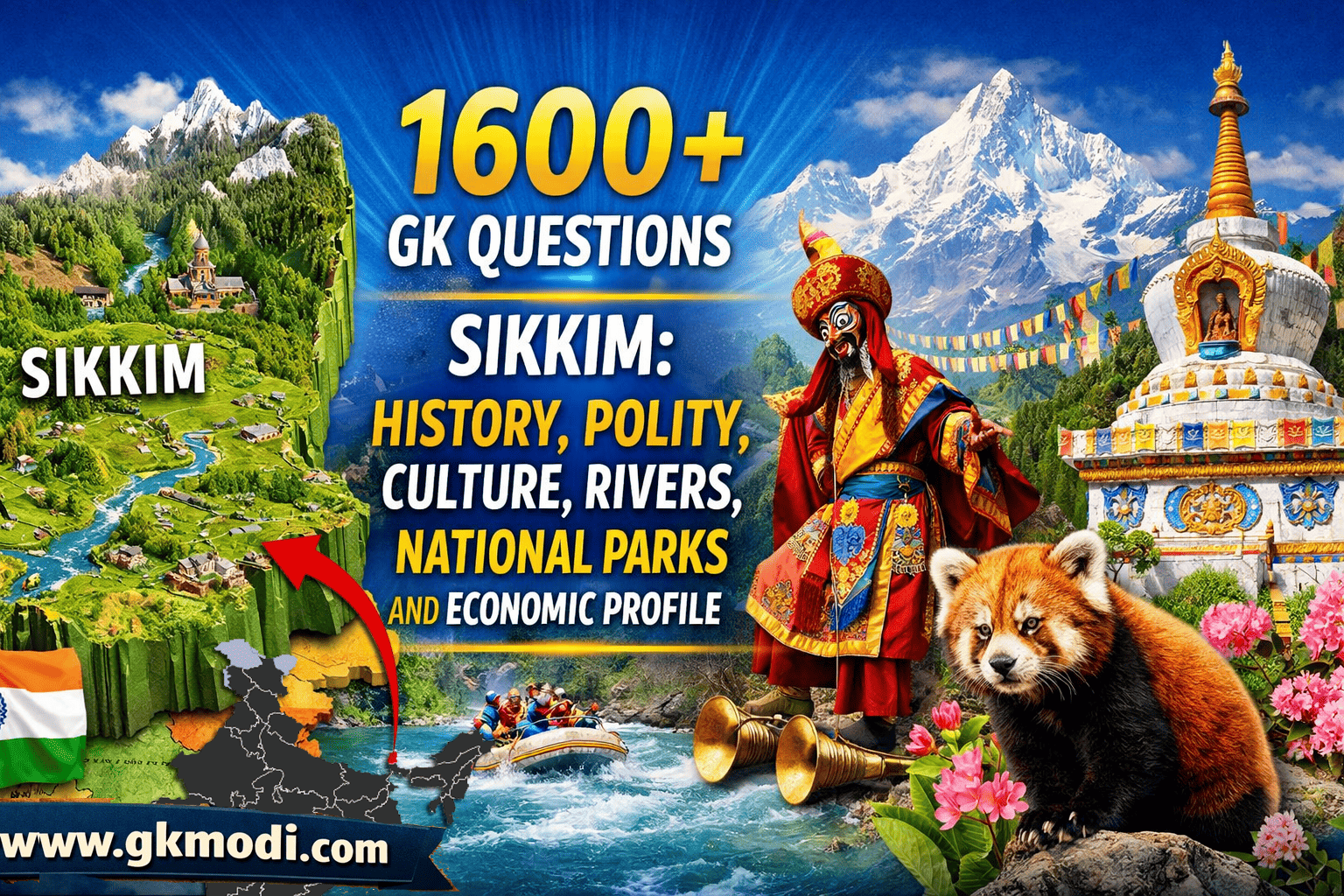
Sikkim Quiz – Complete Guide to Geography, History, Culture & GK Preparation
Focus Keyword: Sikkim Quiz
SEO Title: Sikkim Quiz – 1600+ Sikkim GK Questions and Answers for Competitive Exams
Meta Description: Explore the ultimate Sikkim Quiz guide with detailed GK on geography, history, culture, economy, and tourism. Practice Sikkim GK questions for competitive exams at www.gkmodi.com
Sikkim is a breathtaking Himalayan state in Northeast India known for its spectacular mountains, peaceful monasteries, and rich cultural heritage. Despite being India's second smallest state, Sikkim holds immense geographical, ecological, and strategic importance. It shares international borders with Bhutan to the east, Nepal to the west, and China (Tibet Autonomous Region) to the north, making it a significant frontier region of India.
Sikkim is globally recognized as India's first 100% organic farming state, a milestone that reflects its commitment to sustainable development and eco-friendly agriculture. The state's dramatic landscape includes snow-covered peaks, deep valleys, alpine forests, glacial lakes, and powerful rivers, making it one of the most scenic tourist destinations in India.
The majestic Kangchenjunga (also spelled Khangchendzonga), the third-highest mountain in the world, dominates the skyline of Sikkim. Revered as a sacred guardian deity by local communities, it plays a central role in the state's identity, folklore, and tourism appeal.
The capital city, Gangtok, beautifully blends traditional Tibetan-Buddhist culture with modern urban planning. Clean streets, organized infrastructure, vibrant markets, monasteries, and eco-conscious tourism make Gangtok one of the most attractive hill capitals in India.
This detailed Sikkim Quiz guide is designed for students preparing for competitive exams, including SSC, UPSC, Banking, Railways, State PSC, and other government recruitment tests. It also supports general readers and quiz enthusiasts who want to strengthen their knowledge of Northeast India.
Key Aspects of Sikkim
1. Geography of Sikkim
Sikkim is located in the Eastern Himalayas and covers an area of approximately 7,096 square kilometers, making it one of India's smallest states. Despite its size, it has vast altitudinal variation, ranging from subtropical valleys to snowbound mountain peaks.
Important geographical highlights: Mountainous terrain with steep slopes, numerous glaciers and glacial lakes, fast-flowing rivers and waterfalls, rich biodiversity and forest cover.
The major rivers of Sikkim include the Teesta River and its tributary Rangeet River, which are crucial for irrigation and hydroelectric power generation.
Important high-altitude lakes include: Tsomgo Lake, Gurudongmar Lake, Khecheopalri Lake. These lakes are not only tourist attractions but also hold religious and ecological significance.
2. History of Sikkim
Historically, Sikkim was ruled by the Namgyal dynasty for over three centuries. It functioned as an independent Buddhist kingdom before merging with India.
Key historical milestones: 1642: Establishment of monarchy under the Namgyal rulers, British protectorate period in the 19th century, 1975: Sikkim became the 22nd state of India after a public referendum.
The influence of Tibetan Buddhism remains visible in Sikkim's monasteries, art, festivals, and traditional lifestyle.
3. Culture and Traditions
Sikkim is a multicultural state where different ethnic communities live in harmony.
Major communities include: Lepchas (original inhabitants), Bhutias, Nepalis.
Languages spoken: Nepali (most widely spoken), Bhutia, Lepcha, English and Hindi (official communication).
Important cultural features: Colorful traditional dresses, folk music and mask dances, Buddhist rituals and ceremonies, handicrafts like carpet weaving and wood carving.
Famous monasteries include: Rumtek Monastery, Pemayangtse Monastery, Tashiding Monastery. These monasteries are important centers of spiritual learning and tourism.
4. Economy of Sikkim
Sikkim's economy is primarily based on Organic Agriculture (India's first fully organic state), Hydroelectric Power, and Tourism Industry. Major crops include Large cardamom (largest producer in India), Ginger, Turmeric, and fruits like oranges and apples.
Popular tourist destinations: Pelling, Namchi, Lachung, Yuksom.
5. Biodiversity and Environment
Sikkim is part of the Eastern Himalayan biodiversity hotspot and is home to rare orchids, alpine vegetation, red pandas, snow leopards, and Himalayan black bears. Protected areas include Khangchendzonga National Park, a UNESCO World Heritage Site.
6. Festivals of Sikkim
Major festivals include Losar (Tibetan New Year), Saga Dawa, Pang Lhabsol (worship of Mount Kangchenjunga), Dasain and Tihar, Maghe Sankranti.
7. Importance of Sikkim GK for Competitive Exams
Sikkim-related questions frequently appear in UPSC Civil Services, SSC Exams, Railway Recruitment, Banking Exams, State PSC, and Northeast Regional Exams.
Common exam topics include: Capital and districts, International borders, Mountain peaks and rivers, National parks and biodiversity, Important monasteries, Organic farming initiatives, Cultural festivals.
Why Practice Sikkim Quiz on GKModi?
If you are preparing for competitive exams, practicing topic-wise quizzes improves memory retention and exam confidence.
At GKModi, you can find: ✅ 1600+ Sikkim GK MCQs ✅ Chapter-wise quiz series ✅ Previous year questions ✅ Short notes for revision ✅ Northeast India special quiz sets
Practice Here: www.gkmodi.com
SEO Keywords for Ranking
Primary Keywords: Sikkim Quiz, Sikkim GK Questions, Sikkim General Knowledge, Sikkim MCQs, Sikkim Competitive Exam Quiz
Secondary Keywords: Sikkim Geography Quiz, Sikkim History GK, Sikkim Culture Questions, Northeast India GK Quiz, Organic State of India Quiz
Long-tail Keywords: Important Sikkim GK questions for SSC exams, Sikkim state quiz for competitive exams, 1600+ Sikkim multiple choice questions with answers, Latest Sikkim general knowledge quiz
Conclusion
Sikkim is a unique Himalayan state where natural beauty, spiritual traditions, and sustainable development coexist harmoniously. From the towering Kangchenjunga peak to peaceful monasteries and organic farms, Sikkim offers rich content for competitive exams and quiz preparation.
A well-structured Sikkim Quiz helps students master important facts about geography, history, culture, biodiversity, and economy. Regular practice strengthens general awareness and boosts exam performance.
For comprehensive preparation, detailed MCQs, and chapter-wise quizzes, visit: www.gkmodi.com – India's Trusted GK Platform